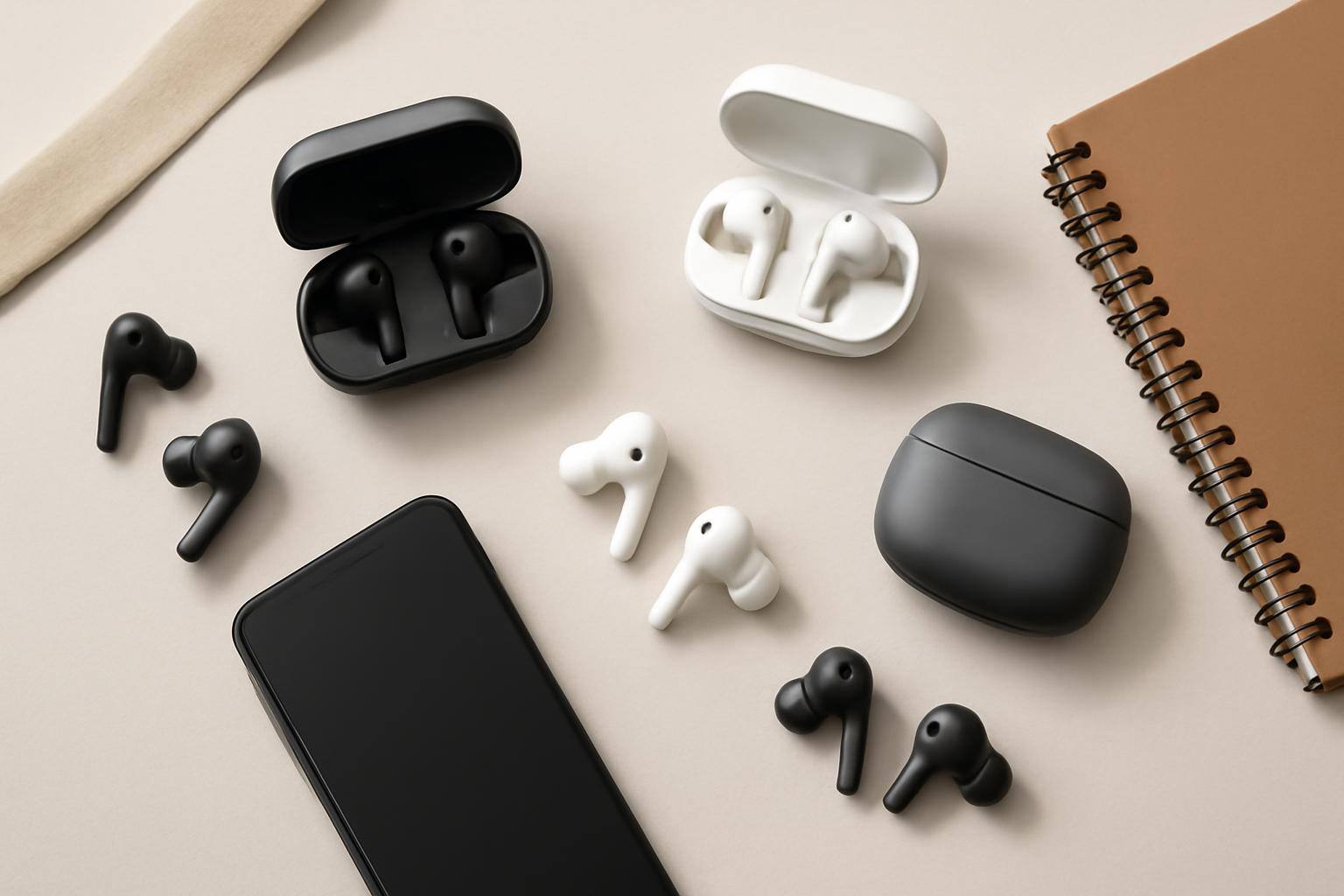
A wireless earbuds buying guide should start with your daily use, not a brand name: choose earbuds that fit securely, work with your phone, provide enough battery for your routine, and include the sound and call features you will actually use. The right wireless earbuds are different for commuting, exercise, work calls, travel, and quiet listening at home, so compare the essentials before focusing on extra features.
Key takeaways
- Choose the earbud shape and ear tips first because a secure fit affects comfort, sound, and noise isolation.
- Check Bluetooth compatibility, controls, and device switching before choosing a model for everyday use.
- ANC reduces unwanted sound around you, while ENC is mainly designed to improve voice pickup during calls.
- Compare battery ratings as a total system: earbuds, charging case, and your actual listening habits all matter.
- Use moderate volume, clean the ear tips regularly, and avoid sleeping with earbuds to make listening more comfortable.
Start with how you will use wireless earbuds
The most useful wireless earbuds buying guide begins by matching the earbuds to the situations where you listen most often. A commuter, a runner, and someone who spends hours on calls may all need different features even when they use the same phone.
For commuting and travel
If you regularly listen on public transport, in cafés, or near traffic, prioritize a stable fit, practical passive isolation from well-fitting ear tips, and active noise cancellation if the model offers it. A charging case is also important for longer days away from a power outlet.
Do not assume that stronger isolation is always the right choice. If you need awareness of announcements, traffic, or people around you, look for an ambient, transparency, or awareness mode and learn how to switch it quickly.
For exercise and walking
If you plan to use Bluetooth earbuds while walking or exercising, focus on stability before sound preferences. Ear tips, wing tips, hooks, or an open-ear design can affect whether the earbuds stay in place when you move.
Check the manufacturer description for any stated water or sweat resistance rating rather than assuming that every wireless model is suitable for workouts. For outdoor movement, retaining some awareness of your surroundings can be more practical than blocking all outside sound.
For calls, meetings, and remote work
If voice calls are your priority, examine microphone information, call-noise processing, comfort for long sessions, and whether you can use one earbud at a time. A quiet room and a windy street create very different conditions, so microphone performance should be considered in the places where you normally call.
For desk use, controls that are easy to find and a case that can stay charged near your workspace may matter more than a compact design. Test return and exchange terms before opening a product if fit is particularly important to you.
Check fit, design, and phone compatibility before features
Fit and compatibility are the foundation of a good wireless earbuds purchase because neither can be fully fixed by software settings. Earbuds that feel unstable or do not connect smoothly to your main device can become frustrating even if their feature list looks strong.
In-ear, semi-in-ear, and open-ear designs
In-ear earbuds sit partly inside the ear canal and often use silicone tips, which can create a closer seal. This design may suit listeners who want a more secure fit and more passive isolation, provided the supplied tip sizes fit comfortably.
Semi-in-ear earbuds rest more lightly near the ear opening and may feel less enclosed for some people. They can be a reasonable option if sealed tips feel uncomfortable, although their fit and outside-noise isolation can differ from in-ear styles.
Open-ear designs leave the ear canal more open and can help you remain aware of nearby sounds. They may suit walking or situations where awareness matters, but they are not automatically the right choice for noisy environments where private listening is important.
Why ear tips deserve attention
Ear tips influence comfort, stability, bass perception, and passive noise reduction. Try the available sizes if they are included, and use the size that seals gently without pressure or the need to push the earbud deeply into the ear.
A loose seal can make listeners raise the volume to hear details, while an overly tight seal may become uncomfortable over time. If one ear needs a different tip size, using different sizes can be more comfortable than forcing the same fit on both sides.
Bluetooth and ecosystem checks
Before choosing Bluetooth earphones, confirm that they work with your phone, tablet, computer, or watch as intended. Bluetooth is designed for wireless connection, but supported features such as companion apps, multipoint connection, voice assistants, and advanced audio options can vary by model and device.
An Apple AirPods buying guide often emphasizes Apple device integration, while other earbuds may be designed around different phone ecosystems or broader cross-platform use. The practical question is not which ecosystem is universally better; it is which functions are clearly supported by the devices you already own.
Compare sound, noise control, calls, and battery realistically
Sound quality, noise control, call clarity, and battery life should be compared as separate factors because one does not guarantee the others. A balanced choice depends on which factor affects your routine most, rather than on a long list of technical terms.
Sound tuning and listening controls
Sound preferences are personal: some listeners prefer fuller bass, while others want clear voices or a more balanced presentation. If an earbud app offers equalizer settings, those controls may help you adjust the sound, but they cannot replace a comfortable and stable fit.
Consider how you listen as well as what you listen to. Podcasts and calls place emphasis on speech clarity, while music listeners may care more about tonal balance, detail, and how the earbuds perform at moderate volume.
ANC and ENC are made for different tasks
ANC, or active noise cancellation, is intended to reduce some unwanted external sound that reaches your ears during listening. ENC, often described as environmental noise cancellation for calls, is generally used to help microphones separate your voice from surrounding noise.
ANC and ENC are not interchangeable. Choose ANC if you want more controlled listening in repeated background noise, and pay attention to microphone and call features if you frequently speak in busy places.
No noise-control feature removes every sound in every setting. Fit, the type of noise, wind, movement, and the way an earbud is worn can all change the result, so treat feature names as a starting point for comparison rather than a promise of silence.
Understanding battery figures
Battery specifications usually distinguish between listening time from the earbuds and additional power stored in the charging case. Compare the stated conditions carefully, because volume level, calls, active noise cancellation, and other enabled features can affect real-world battery use.
Choose a case size and charging method that fits your habits. If you rarely remember to charge devices overnight, a case with sufficient reserve power may be more useful than a feature you will only use occasionally.
Use a simple shortlist to make the final decision
A practical earbuds buying guide does not require comparing every model on the market. Create a shortlist of a few options that meet your required fit, compatibility, and everyday use, then eliminate choices that lack the functions you genuinely need.
Set your non-negotiables first
Write down three requirements before browsing. For example, you may need a secure exercise fit, clear calls for work, or a transparency mode for commuting; these needs make it easier to ignore features that sound interesting but will not change your daily experience.
If you use both a phone and a laptop, check whether the earbud model supports the way you switch between them. If you mainly use one phone for short listening sessions, simple controls and comfort may be more valuable than advanced connection features.
Read product details with the right questions
When comparing product pages, look for stated compatibility, included accessories, control methods, charging information, fit design, and any listed resistance rating. Product descriptions should answer specific questions; when a detail is not listed, do not assume it is included.
Reviews can be useful for learning about different ear shapes and routines, but individual comfort is highly personal. Give more weight to consistent, specific comments about fit, controls, or a use case similar to yours than to broad statements with no context.
Common mistakes to avoid
- Choosing only by brand without checking fit, device compatibility, and intended use.
- Assuming active noise cancellation and call-noise reduction perform the same job.
- Comparing only the largest battery number without reading the stated conditions.
- Ignoring ear tip sizes and then judging sound quality with an incomplete seal.
- Using maximum volume to overcome poor fit or loud surroundings.
- Assuming a water resistance claim covers every activity without checking its stated rating and guidance.
Use and maintain wireless earbuds thoughtfully
Wireless earbuds are easier to live with when you use moderate volume, keep the ear tips and charging contacts clean, and store them in their case when not in use. Good habits help maintain comfort and reduce avoidable connection or charging issues.
The commonly discussed 60-60 rule is a simple listening habit: keep volume at or below about 60 percent when practical and take a break after around 60 minutes. It is not a universal medical rule, because safe exposure also depends on the actual sound level, how long you listen, and the environment.
Clean earbuds gently according to the manufacturer instructions, especially around removable tips and charging contacts. Avoid inserting sharp objects into speaker openings, and let earbuds dry fully before placing them in a charging case if they have been exposed to moisture.
If earbuds cause pain, persistent ringing, or noticeable hearing changes, stop using them and seek advice from an appropriate healthcare professional. No earbud type is inherently safest for everyone; comfortable fit, appropriate volume, regular breaks, and awareness of your environment are the more useful safety considerations.
Frequently asked questions about wireless earbuds
What should I look for when buying wireless earbuds?
Look for a secure and comfortable fit, compatibility with your main devices, suitable battery capacity, clear controls, and features that match your routine. For noisy travel, consider ANC; for frequent calls, prioritize microphone and call-noise features.
What is the 60-60 rule for earbuds?
The 60-60 rule suggests listening at about 60 percent volume or lower and taking a break after roughly 60 minutes. It is a practical reminder to avoid long, loud listening sessions, not a guarantee of safe exposure in every situation.
Which is better, ANC or ENC?
ANC is better suited to reducing some surrounding noise for the listener, while ENC is generally intended to improve voice pickup during calls. Choose based on whether you need quieter listening, clearer calls, or both features.
What brand is good for wireless earbuds?
A good wireless earbud brand is one that offers a model compatible with your devices and transparent information about fit, battery, controls, and supported features. Brand reputation can be useful, but it should not replace checking the specifications and use case of the individual model.
Which type of earbuds is safest?
No earbud style is automatically safest for every person or situation. Choose a comfortable fit, keep volume moderate, take listening breaks, and use awareness features or an open design when you need to hear your surroundings.
Choose the features that support your everyday listening
The right wireless earbuds are the pair that fits comfortably, connects reliably to your usual devices, and supports the way you listen each day. Use this wireless earbuds buying guide to narrow your choices by fit, compatibility, noise needs, calls, battery expectations, and safe listening habits.
When you are ready to compare available items, review each product page at RankX Demo Store (English) for the details provided by the manufacturer and choose only the features that serve your own routine. A deliberate shortlist is more useful than chasing every new feature in a Bluetooth earbuds buying guide.
Leave a Reply